Best TENS Unit for Neck and Shoulder: TENS 7000 Leads

A wired TENS 7000 still beats newer wireless kits for neck and shoulder placement. Here is which of six picks fits which shoulder, and where the wireless AUVON earns its keep.

By Elsie DuncanUpdated 16 min read
On this page
- Best TENS unit for neck and shoulder at a glance
- How I cut the category down to six
- Why neck and shoulder is the hardest place to pad up
- 1. TENS 7000 Digital TENS Unit — Best overall
- 2. AUVON Wireless 24 Modes TENS Unit — Best premium
- 3. MASTOGO 12 Modes Wireless TENS Unit — Best upgrade
- 4. AVCOO 3-in-1 TENS Unit — Best for pros
- 5. AVCOO 30 Modes TENS EMS Unit — Best minimal setup
- 6. CESLIFF Dual Channel TENS EMS Unit — Best budget pick
- Wired or wireless: which wins on the traps?
- How many pads do you actually go through?
- What the listings will not tell you
- The verdict
- FAQ
The best TENS unit for neck and shoulder use is the TENS 7000 Digital TENS Unit, because its long lead wires and manual control let you place two pads across the trapezius without fighting a pod that wants to sit on the muscle itself. If you cannot tolerate a wire running under your collar, the wireless AUVON 24-mode unit is the better buy, with its 790 mAh charging case rated for up to 40 hours per charge.
Best TENS unit for neck and shoulder at a glance
| Pick | Channels & control | Pads in box | Price |
|---|---|---|---|
Best overall TENS 7000 Digital TENS Unit |
Dual channel, wired, manual dials | 4 reusable pads | Check Price |
Best premium AUVON Wireless 24 Modes TENS Unit |
Wireless pods, 24 modes, 30 intensities | 6 pads | Check Price |
Best upgrade MASTOGO 12 Modes Wireless TENS Unit |
Wireless, app-controlled, 12 modes | Not listed | Check Price |
Best for pros AVCOO 3-in-1 TENS Unit |
Wired, 24 modes, 40 levels, EVA case | 12 pads (two sizes) | Check Price |
Best minimal setup AVCOO 30 Modes TENS EMS Unit |
Wired dual channel, 30 modes, 30 levels | 12 pads | Check Price |
Best budget pick CESLIFF Dual Channel TENS EMS Unit |
Dual channel, 24 modes, 36 levels, large LCD | 10 pads | Check Price |


How I cut the category down to six
I started with a much longer list and cut it three ways. First, anything that was disqualified on principle: single-channel units, because a stiff trapezius almost always benefits from pads on both sides of the spine at once. Second, anything without a published mode count or intensity range, because you cannot compare units on "advanced technology" alone. Third, anything with fewer than two pads in the box, since the neck and shoulder ask for at least a pair per session and usually four.
What survived is six units that all list dual channels or wireless pod pairs, all include pads, and all name a specific mode count. The TENS 7000 sells fastest of the six by a wide margin, which is one signal. The AUVON wireless is the newest published design here. The two AVCOO units come from the same brand at different sizes. The CESLIFF and MASTOGO sit at opposite ends of the interface question, one with a large physical screen, one controlled from a phone. That spread is the point. A best TENS unit for neck and shoulder shortlist has to include both approaches, because the two solve different problems.
Why neck and shoulder is the hardest place to pad up
Most guides compare TENS units on mode count. That is not what decides it for the neck and shoulder. The deciding factor is whether you can place two pads far enough apart to bracket the muscle without the control unit itself landing on the muscle you are trying to treat.
A wired unit puts the box on your hip or in your pocket, so the pads sit flat on the trapezius. A wireless unit puts the electronics on the pad. That is convenient for a bicep or a calf. On the neck and shoulder it means a rigid pod perched right where you are trying to relax, sometimes pressing against a shirt collar or a car seat.
Here is the trick with this category: read the pad layout before you read the mode list. Two pads at least four inches apart, connected to a small box on your belt, is the format the neck and shoulder was built for. Everything else is a compromise you accept for the sake of losing the wire.
1. TENS 7000 Digital TENS Unit — Best overall
The wired dual-channel format is exactly what the trapezius wants, and this unit is the one buyers choose most often here.
Best for: someone who wants long lead wires and full manual control over the traps and rear delts Skip it if: you refuse to have any cable running down your back
The TENS 7000 is a 1.15 lb black handheld measuring 7.75 x 8.75 x 2 in, released in 2017 and still sells faster than every other pick in this set by a wide margin. Two lead wires, four reusable pads, dual channels with independent intensity dials. That is the whole point. You can put one channel on the left trapezius and one on the right, dial each side up to what that side actually needs, and adjust without unlocking a phone.
TENS 7000 says the unit has been sold over three million times and has been favoured by medical professionals since 2008. Read that as manufacturer copy, not as a spec. What is verifiable from the listing is the format: analog dials, physical controls, dual channels, medical-grade unit. It ships with everything needed to start a session, which none of the wireless picks here can quite match.
The trade-off is the wire. If your objection to TENS is the tether, this is not your unit.
Pros:
- Dual channels with independent intensity dials
- Long lead wires reach across both shoulders
- Sells faster than any other pick here
- Ships ready to use with pads and wires
- Manual controls, no app or Bluetooth pairing
Cons:
- Wire from unit to pads is unavoidable
- Bulkier than the wireless pods at 1.15 lb
- The most expensive wired pick here
2. AUVON Wireless 24 Modes TENS Unit — Best premium
The wireless format that actually earns its price position, with a 790 mAh charging case AUVON rates at up to 40 hours.
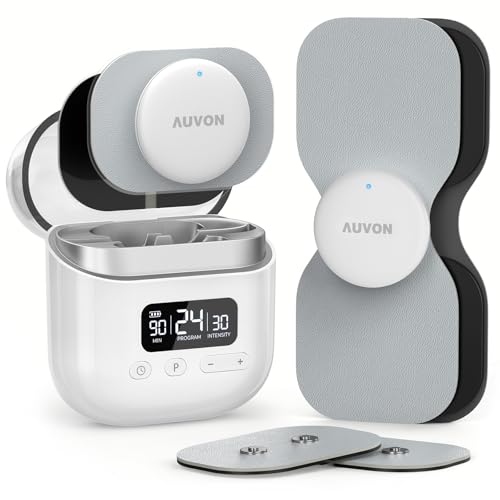
Best for: commuters and desk workers who want no wire from collar to unit Skip it if: you need to place two pads on opposite shoulders at once
The AUVON TX6224 is a white wireless system with six pads. AUVON claims a 10-minute fast charge delivers about an hour of relaxation, with a full charge lasting up to 40 hours from the 790 mAh case. The unit offers 24 modes and 30 intensities combining TENS, EMS and massage therapy. AUVON says its pads are medical-grade and latex-free, and that the brand is physical therapist recommended. Take the recommendation line as marketing.
Why this is the premium pick and not the overall winner: it is the most expensive pick in the set, and the wireless pod format means each pod sits on the muscle. On the neck and shoulder, that is a real limitation. One pod on the trapezius works well. Two pods bracketing the spine works less well, because each pod is a rigid object rather than a flexible pad on a wire.
The trade-off is the wired case. You lose the tether. You gain a pod on the muscle.
Pros:
- No wire between pad and unit
- 790 mAh case rated up to 40 hours per charge
- 24 modes and 30 intensities
- Six pads in the box
- Two sellers list it, more than the rest of the set
Cons:
- Pods sit on the muscle you are treating
- Most expensive pick here
- Charging case adds a step before use
3. MASTOGO 12 Modes Wireless TENS Unit — Best upgrade
The wireless pick that puts session control on your phone through the DOMAS app.

Best for: phone-first users who want app control and preset massage feels Skip it if: you do not want a session tied to a working Bluetooth connection
The MASTOGO is a purple wireless unit measuring 0.7 x 7.48 x 2.91 in. MASTOGO says the DOMAS app runs on iOS and Android and connects over Bluetooth, giving you 12 modes split as six TENS and six EMS presets such as kneading, squeezing and tapping. MASTOGO also claims upgraded adhesive electrode pads that clean easily.
This is the upgrade pick because the app is a real difference in how you run a session. You can change mode without reaching over your shoulder, which matters more on the neck and traps than anywhere else on the body. In practice, the app is also the reason the unit sits between wired simplicity and full wireless freedom: the pods are the electronics, but the interface is your phone.
The published specification list is thin compared to the AUVON or the wired picks. Pad count is not listed. Battery life is not listed. Mode count is the headline number, and 12 is the lowest in this set. You are paying for the interface, not the feature count.
Pros:
- DOMAS app on iOS and Android
- Bluetooth control without reaching for the unit
- Six TENS and six EMS preset feels
- Compact profile at 0.7 in thick
Cons:
- Pad count not stated on the listing
- Battery life not stated on the listing
- Lowest mode count of the six
- Depends on a Bluetooth pairing to run
4. AVCOO 3-in-1 TENS Unit — Best for pros
The pick with the most pads in the box and a moisture-resistant EVA travel case, sized for a working kit bag.

Best for: physios and coaches carrying a kit between clients Skip it if: you only ever treat one spot at home
The AVCOO TA2224C is a red wired unit AVCOO describes as a 3-in-1 combining TENS, EMS and RELAX functions. It has 24 pre-programmed modes and 40 intensity levels, which is the widest range in this set. It ships with 12 reusable pads in two sizes, packed in a moisture-resistant EVA travel case, which is the only case AVCOO specifically calls out here.
This is the pro pick because of the pad count and the case. Twelve pads in two sizes gives you fresh pairs across sessions and lets you match pad size to the area, which for a neck and shoulder application matters: smaller pads bracket the levator scapulae more precisely than the big rectangles most kits ship. AVCOO says the pads are latex-free and reusable more than 50 times.
The trade-off is that this unit sells slowest of the six. Read that as a niche fit rather than a flaw. If you are not carrying it between rooms, the AVCOO 30-mode pocket unit below covers the same brand at a smaller size.
Pros:
- 12 pads in two sizes for varied placement
- 40 intensity levels, the widest range here
- Moisture-resistant EVA travel case included
- Dual channel wired control
Cons:
- The slowest seller of the six
- Overkill for a single home user
- No mode count or battery figure that beats the AUVON
5. AVCOO 30 Modes TENS EMS Unit — Best minimal setup
The smallest wired unit in the set, at 0.09 lb and 4.8 x 1.3 x 0.5 in, with 30 modes and 30 intensity levels.

Best for: a first-time buyer who wants the smallest possible pocket unit Skip it if: you want a large screen you can read without glasses
The AVCOO TU1130 is a black wired unit AVCOO gives dimensions of 4.8 x 1.3 x 0.5 in at 0.09 lb, with 30 modes, 30 intensity levels, and what the listing describes as up to 30 hours of usage per charge. It is a 2-in-1 combining TENS and EMS. AVCOO claims medical-grade pads made with an American gel that reuses more than 50 times, and ships 12 pads in the box.
This is the minimal setup pick because it strips a TENS unit down to what matters. Two channels. A memory function so you can resume the last session. A body so small it fits inside a shirt pocket. Nothing else. For a neck and shoulder application that means you can leave the unit clipped to a collar without noticing it is there, and the wires do the work of reaching the traps.
The screen is small. That is the deliberate compromise. If you want to read the mode number across the room, the CESLIFF is the pick with the enlarged display.
Pros:
- 0.09 lb pocket-sized wired unit
- 30 modes and 30 intensity levels
- 12 pads in the box
- Memory function resumes the last session
Cons:
- Small screen, harder for older eyes
- Colour listed only as black, no other options published
- Sales rank behind the TENS 7000 and MASTOGO here
6. CESLIFF Dual Channel TENS EMS Unit — Best budget pick
The cheapest of the six, with a large LCD screen and enlarged buttons designed to be read at arm's length.

Best for: older users who want big buttons and a readable screen at the cheapest position here Skip it if: you want the fewest published specifications to go on
The CESLIFF is a black dual-channel wired unit. CESLIFF describes it as 24 modes and 36 intensity levels, with independent A and B channel control, a rechargeable body, and 10 pads in the box. The large LCD is the specific feature CESLIFF calls out for older users, along with enlarged icons and buttons.
This is the budget pick because it is the cheapest of the six and still ships with dual channels and 10 pads. Six massage feels are listed by name: kneading, acupuncture, scraping, tapping, shiatsu-deep, and one further mode. CESLIFF says independent A and B intensity is the point, so you can run the left trapezius softer than the right on the same session. For a neck and shoulder application, that asymmetry matters more than another five modes would.
The trade-off is spec sparseness. CESLIFF publishes fewer figures for this unit than the AVCOO or the AUVON: no weight, no dimensions on the listing at hand, no battery life. You are buying on the interface claim and the channel count.
Pros:
- Cheapest of the six
- Large LCD and enlarged buttons
- Independent A and B channel intensity
- 10 pads in the box
Cons:
- Fewer published specifications than the rest of the set
- No stated weight or dimensions
- Slowest wired seller here
Wired or wireless: which wins on the traps?
Wired wins on the trapezius, and wireless wins on the deltoid. Here is why.
The trapezius runs from the base of the skull along the top of the shoulders and down to the mid-back. Treating it well means bracketing the muscle: one pad above, one pad below, wired to a control unit that sits somewhere other than on the muscle itself. The wired TENS 7000 does this in exactly the layout the muscle asks for.
A wireless pod, on the other hand, is a small rigid disc that lives on the pad. On the front or side of a deltoid you barely notice it. On the top of the trapezius, under a shirt collar, against a car headrest, the pod is right where you want soft tissue to relax. It presses on the muscle rather than communicating with it.
That does not mean wireless is wrong for this category. It means the wireless format is best when you are treating the shoulder joint or the front of the shoulder, not the upper trapezius. A commuter who wants relief across a workday will still choose the AUVON. A weekend user who sits down for a 20-minute session at home is better served by wires.
The cutoff is where you use it. Stationary use at home: pick wired. Use in transit or through a workday: pick wireless.
How many pads do you actually go through?
Pad life is the running cost of TENS therapy, and buyers underestimate it.
AVCOO and AUVON both say their pads are reusable more than 50 times. That is a manufacturer claim, and the real number depends on your skin, your sweat, and how carefully you peel and reseat the pad every session. In practice, pads on the neck and shoulder wear faster than pads on a bicep, because the skin has more hair and more oil there.
Here is a rough usage picture, drawn only from what the listings publish:
- A daily 20-minute session on both traps uses two pads at once.
- Most listings claim reuse for "more than 50 times" per pad.
- That gives roughly 50 sessions per pair before adhesion drops.
- A four-pad box like the TENS 7000 covers around 50 sessions total.
- A 12-pad box like the AVCOO covers roughly 150 sessions before you reorder.
Read those as ceilings, not floors. The point is that a bigger box is a real advantage over a longer feature list, because you will buy pads either way. If pad count matters to your budget, the two AVCOO units and the CESLIFF ship the most.
What the listings will not tell you
A few things the product pages skip that you should know before you commit.
- How the pads adhere on hair. None of the listings say. The neck and shoulder has more hair than most placement zones, and adhesion drops the first time you peel a pad off skin with any hair on it.
- Whether the wireless pods fit under a shirt. AUVON and MASTOGO both publish overall size but neither states thickness in a way that tells you if a collared shirt will sit flat over the pod.
- What "medical-grade" means on the pad. Every brand here uses the phrase. None defines it. Treat it as marketing.
- Real battery life in the wireless units. AUVON says up to 40 hours per full charge from the 790 mAh case. That is a ceiling. MASTOGO does not publish a battery figure at all.
- Warranty terms. None of the six lists a specific warranty length in the data available here, so treat pad life and unit reliability as things you will have to judge yourself.
The pattern across all six listings is that mode count is easy to publish and durability is not. Buy on the format and the pad count. Assume the mode names describe similar feels across brands.
The verdict
The best TENS unit for neck and shoulder is the TENS 7000 Digital TENS Unit. The reason is layout: dual channels on a wired handheld, with lead wires long enough to bracket the trapezius and a control box that sits on your belt rather than on the muscle. It is 1.15 lb, dimensions 7.75 x 8.75 x 2 in, released in 2017, and sells faster than every other pick in this set.
Two conditions flip the recommendation. First, if you need the unit to work during a commute or across a workday, the AUVON Wireless 24 Modes unit is the better buy: 24 modes, 30 intensities, and a 790 mAh case AUVON rates at up to 40 hours per charge. Second, if you are carrying the kit between clients rather than treating yourself, the AVCOO 3-in-1 wins on pad count and case, with 12 pads in two sizes and a moisture-resistant EVA bag.
The CESLIFF and the AVCOO 30-mode pocket unit are the answers on price and portability. The MASTOGO is the pick if app control matters more than published specs. None of the six is a bad TENS unit for neck and shoulder. The TENS 7000 is simply the one whose format matches the muscle group best.
FAQ
Is a TENS unit worth it for chronic neck and shoulder pain?
A TENS unit is worth trying if the pain is muscular and recurring, and if you have already ruled out anything acute with a clinician. The picks here are drug-free electrical stimulation devices, not treatments for underlying conditions. The TENS 7000 is the format most professionals use because of its dual-channel wired layout, which is what makes it a defensible starting point.
What is the difference between the TENS 7000 and the AUVON wireless unit?
The difference is the wire. The TENS 7000 is a 1.15 lb wired handheld with two lead wires and four pads, controlled by physical dials. The AUVON is a wireless pod system with a 790 mAh charging case, 24 modes and 30 intensities. Wired is better on the trapezius. Wireless is better on the go. Which one suits you depends on where you plan to sit while using it.
Can I use a TENS unit on both sides of the neck at once?
You can use a TENS unit on both sides of the neck at once if it has two channels, which every pick in this roundup does. Dual channels let you run the left trapezius at one intensity and the right at another, which matters when one side is tighter than the other. The CESLIFF specifically calls out independent A and B channel intensity control.
How many pads come with each of these TENS units?
The pads counts range widely across this set. The TENS 7000 ships four reusable pads. The AUVON wireless ships six. The AVCOO 3-in-1 and the AVCOO 30-mode pocket unit each ship 12 pads, the AVCOO 3-in-1 in two sizes. The CESLIFF ships 10 pads. The MASTOGO listing does not state a pad count. Bigger boxes lower running cost.
What should I avoid when buying a TENS unit for neck and shoulder?
Avoid single-channel units, avoid units that do not publish a mode count, and avoid choosing on mode count alone. The neck and shoulder wants two pads bracketing the muscle, which means dual channels are the real threshold. Beyond that, the deciding factor is format: wired for stationary home use, wireless for movement across a day. Pad count matters more than another five preset modes.
Start with where you will actually use it. A wired TENS 7000 on the couch after work is a different product from a wireless AUVON worn under a shirt at a desk, and neither replaces the other. If you are treating one spot at home and want a unit you will still be using in three years, the TENS 7000 is the safe default. If you want to feel relief without a cable at your collar, spend the extra on the AUVON and accept that the pods will sit on the muscle rather than beside it. Whichever way you go, buy extra pads with the unit.