Best Magnifying Glass When Your Hands Get Tired
Six handheld magnifiers compared on lens width, weight, light count and power source, with a named winner and the conditions that flip the pick to something else.

By Elsie DuncanUpdated 16 min read
On this page
- Best magnifying glass at a glance
- How I screened these six magnifying glass picks
- Lens width or magnification: which decides it?
- 1. JMH Magnifying Glass with Light — Best overall
- 2. GABORISH Large Magnifying Glass with 37 LED Light — Best for pros
- 3. AIXPI Magnifying Glass with Light Large 5" Lens — Best minimal setup
- Batteries or USB charging: what should you pick?
- 4. HQGZQL Large Magnifying Glass with Lights — Best large-capacity
- 5. Magnus Opus 45X Magnifying Glass with Light — Best premium
- 6. HQGZQL 10X 30X Magnifying Glass for Reading — Best budget pick
- How heavy is too heavy for a reading session?
- What the listings do not tell you
- The verdict
- FAQ
The best magnifying glass here is the JMH Magnifying Glass with Light, because a 3.15-inch lens and 18 LEDs in a 0.61 lb body cover almost every reading job without straining your wrist. If you inspect coins or circuit boards instead of reading, the GABORISH Large Magnifying Glass with 37 LED Light is the better buy, thanks to its 10X, 20X and 45X inlets. Magnification is what splits this field, and it splits it more sharply than the listings admit.
Best magnifying glass at a glance
| Pick | Lens / claimed power | Light & power | Price |
|---|---|---|---|
Best overall JMH Magnifying Glass with Light |
3.15 in lens | 18 LED, 3 modes 3x AAA |
Check Price |
Best for pros GABORISH Large Magnifying Glass with 37 LED Light |
5.2 in lens 10X/20X/45X claim |
37 LED, dimmable 1000mAh USB |
Check Price |
Best minimal setup AIXPI Magnifying Glass with Light Large 5" Lens |
5 in lens | 24 LED + 1 UV 3x AAA |
Check Price |
Best large-capacity HQGZQL Large Magnifying Glass with Lights |
5 in lens 10X/25X/45X/60X claim |
LED, 3 colour temps Batteries |
Check Price |
Best premium Magnus Opus 45X Magnifying Glass with Light |
4.6 in lens 45X claim |
LED, 6 colour modes 1200mAh USB |
Check Price |
Best budget pick HQGZQL 10X 30X Magnifying Glass for Reading |
3.54 in lens 10X/30X claim |
No light None needed |
Check Price |



How I screened these six magnifying glass picks
I weighted four criteria, in this order, and the ranking follows them.
- Lens width. A wider lens shows more words at once, which is what actually makes reading comfortable. Published lens figures here run from 3.15 in to 5.2 in.
- Grip weight. Anything you hold over a page for twenty minutes is a weight-lifting exercise. The lightest here is 3.21 oz; the heaviest published figure is 8 oz.
- Light. Five of the six list built-in LEDs. Counts run 18, 24, 37 and unspecified, with two offering colour-temperature control.
- Power source. Two charge over USB, three take 3x AAA cells, one needs no power at all.
Why that order? Because lens width and weight are the two things you cannot fix after purchase. A dim light can be supplemented by the lamp on your desk. A cramped lens cannot be widened, and a heavy handle cannot be lightened.
What that screening exposed: only one pick in the set has no light at all, only two are rechargeable, and only one publishes no weight figure whatsoever. Those three gaps did more to separate these products than any magnification number on the box.
Lens width or magnification: which decides it?
Most shoppers compare the biggest number on the package. 45X sounds four times better than 10X. It isn't, and the listings themselves quietly explain why.
GABORISH states that its 45X inlet gives an upright image within 1.2 in. HQGZQL is blunter still on its four-power model: 10X works at 3 to 5 inches, 25X at 1 inch, and 45X closer than that. So a high-power inlet is not a stronger reading lens. It is a small window you press almost against the object.
That is the trap. High magnification shrinks the field of view and shortens the working distance at the same time. For reading a prescription label, both changes make the job harder, not easier.
Here's the trick with a magnifying glass: the number that decides your comfort is lens diameter, because it sets how much of the page you see in one look.
- 3.15 in to 3.54 in shows a few words. Fine for a coupon or a bottle label.
- 4.6 in to 5 in shows most of a paragraph. This is the sweet spot for books and newspapers.
- 5.2 in is the widest published face in this set, on the GABORISH.
High-power inlets are a bonus feature, not a headline. Treat them that way and the field reorders fast.
1. JMH Magnifying Glass with Light — Best overall
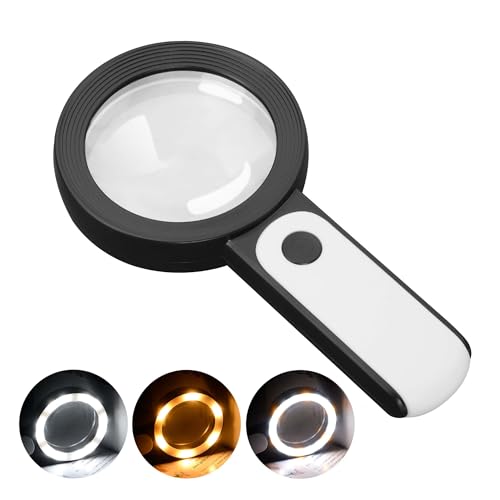
The JMH balances a usable 3.15-inch lens against the lightest lit body in this set, and it is the one buyers choose most often here.
Best for: daily newspaper and label reading at a table Skip it if: you inspect stones or solder joints
Two figures explain this pick. It weighs 0.61 lb, which is lighter than every other lit magnifier here that publishes a weight. And the whole tool measures 8.07 in long by 4.17 in wide, so the handle carries a lens that fills your hand without dominating it.
JMH says the 18 LEDs run in three modes, mixing cold and warm light. That matters more than raw brightness. Cold light sharpens print contrast on newspaper; warm light is easier on the eyes for a long sitting. The brand also states the 3.15 in lens magnifies without optical distortion, which is a claim rather than a measured figure, though a single-power lens has fewer chances to disappoint than a stack of inlets.
It runs on 3x AAA cells, not included, and there is a single on-off button. No app, no dial, no charging cable to lose.
The trade-off is reach. This is the narrowest lit lens in the set and it publishes no high-power inlet, so detailed inspection work goes elsewhere. Only one seller lists it, too.
Pros:
- Lightest published weight among the lit picks, 0.61 lb
- Three light modes mixing cold and warm output
- Single-button operation, nothing to learn
- The one buyers choose most often in this set
- Slim 0.04 in profile stores flat in a drawer
Cons:
- Narrowest lens of the five lit picks at 3.15 in
- No high-power inlet for coins or stones
- AAA batteries not included
- Only one seller lists it
2. GABORISH Large Magnifying Glass with 37 LED Light — Best for pros
The widest lens and the most LEDs in this set, plus three magnification steps for inspection work.

Best for: coin, stamp and circuit-board inspection Skip it if: you want the lightest thing in the drawer
This is the specification-heaviest pick here. The lens measures 5.2 in, the largest published figure in the set, and GABORISH lists 37 LEDs with adjustable brightness. It sits in the most expensive tier here.
The magnification story is the reason to buy it. GABORISH claims 10X on the main lens with 20X and 45X inlets, and it publishes the caveat honestly: the 45X inlet gives an upright image within 1.2 in. So you get a wide reading lens and two close-inspection windows in one body, which no other pick in this set combines.
Power is USB rechargeable from a 1000mAh cell. That removes the AAA habit, and the adjustable brightness is genuinely useful on reflective surfaces like a coin slab or a glossy datasheet.
The cost is bulk. At 8 oz it is the heaviest published weight here, and the body runs 10.8 in long by 5.5 in wide, which is a lot of tool to hold steady over a page. That size buys capability, not comfort. If your session is an hour of reading rather than ten minutes of inspection, the JMH is easier on the wrist.
Pros:
- Widest published lens in this set at 5.2 in
- Most LEDs here, 37, with adjustable brightness
- Three magnification steps in one body
- USB rechargeable, 1000mAh, no AAA cells
- Listing states the 45X working distance plainly
Cons:
- Heaviest published weight in the set at 8 oz
- Largest footprint, 10.8 x 5.5 in
- Sits in the most expensive tier here
- The 45X inlet is unusable beyond 1.2 in
3. AIXPI Magnifying Glass with Light Large 5" Lens — Best minimal setup
A 5-inch lens in a 5.12 x 5.12 in body, which is the tightest lens-to-size ratio here.
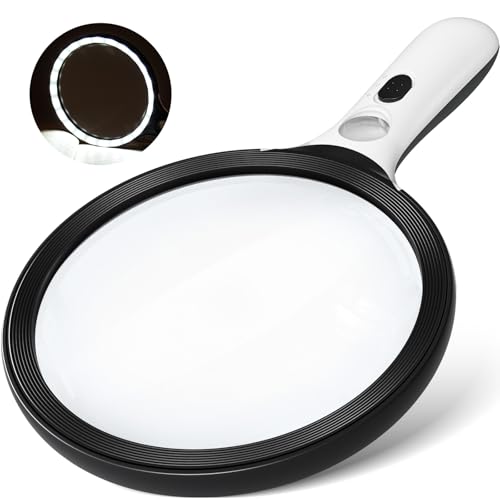
Best for: the widest lens face in the smallest body Skip it if: you need adjustable brightness
Look at the geometry. The lens is 5 in and the whole product measures 5.12 x 5.12 in. Almost nothing here is handle or frame. Compare that to the GABORISH, which needs 10.8 in of length to carry a 5.2 in lens, and you can see where the space goes.
At 0.55 lb this is also the lightest published weight of any lit magnifier in the set, undercutting even the JMH. That combination, a wide lens on a light body, is unusual and it is the whole reason this pick sits third.
AIXPI lists 24 LEDs plus one UV light, and describes two precision lenses giving high magnification. The UV bulb is a niche extra, aimed at checking banknotes or currency marks. One button, 3x AAA cells, ready out of the box.
Two gaps hold it back. The listing publishes no magnification figure at all, only "high magnification", so you're buying an unspecified power. And there is no mention of brightness or colour-temperature control, which both the GABORISH and the Magnus Opus offer. For a lamp-lit desk that's fine. For varied conditions, the adjustable picks win.
Pros:
- Lightest lit pick here at 0.55 lb
- 5 in lens in a 5.12 x 5.12 in footprint
- 24 LEDs plus a UV bulb for note checking
- One-button operation, no setup
Cons:
- No magnification figure published anywhere
- No brightness or colour adjustment
- AAA cells not included
- Compact handle gives less leverage than the longer picks
Batteries or USB charging: what should you pick?
Three of these six magnifying glass picks take 3x AAA cells. Two charge over USB. One needs no power at all. That split matters more than it looks.
AAA cells win on two counts. They are swappable mid-session, and a dead battery does not mean a dead tool for two hours. The JMH and the AIXPI both state that cells are not included, so plan on a pack arriving with your order.
USB charging wins on running cost and clutter. The GABORISH lists a 1000mAh cell, the Magnus Opus a 1200mAh cell, and neither asks you to keep a battery drawer. The larger cell also tends to be the one paired with the fancier light: six colour modes on the Magnus Opus, adjustable brightness on the GABORISH.
Then there's the HQGZQL 10X 30X, which has no light and needs no power. In a bright room by a window, that is not a compromise. It's a simpler tool.
My rule of thumb: if the magnifier lives in one spot near an outlet, take USB. If it travels in a bag or lives in a kitchen drawer, take AAA and keep spares.
4. HQGZQL Large Magnifying Glass with Lights — Best large-capacity
Four claimed magnification steps, 10X through 60X, on a 5-inch acrylic lens.

Best for: switching between four magnification steps Skip it if: you dislike buying AAA batteries
This is the only pick here claiming four powers rather than one, two or three. HQGZQL lists 10X, 25X, 45X and 60X, and to its credit it publishes the working distances: 10X at 3 to 5 inches, 25X at about 1 inch, with 45X closer still. That transparency is worth more than the headline number.
The lens is 5 in acrylic, in a 5 x 5 in body weighing 0.71 lb. HQGZQL argues acrylic beats glass on weight and durability, which is a fair trade if you drop things, though acrylic scratches more readily than mineral glass. The extended handle is designed for long holds.
Light is adjustable across three colour temperatures, putting it between the fixed-output picks and the six-mode Magnus Opus.
The catch is stacking. Every extra inlet takes lens area away from the main reading window, so a four-power lens gives you less clear 10X space than a single-power lens of the same diameter. It also runs on batteries while the two premium picks recharge. Sits roughly mid-range for this set, and it's one of the slower sellers of the six.
Pros:
- Four claimed powers, 10X through 60X
- Working distances published for each step
- Three adjustable colour temperatures
- 5 in lens in a compact 5 x 5 in body
Cons:
- Inlets eat into the main reading area
- Acrylic scratches more easily than glass
- Battery powered, not rechargeable
- One of the slower sellers of the six
5. Magnus Opus 45X Magnifying Glass with Light — Best premium
Six LED colour modes and a 1200mAh cell, the largest published battery in this set.

Best for: long cordless sessions with tuned light colour Skip it if: you want a published weight before buying
Two figures set this apart. The battery is 1200mAh, larger than the GABORISH's 1000mAh, and the light offers six colour modes against three on the JMH and HQGZQL. Magnus Opus describes warm, white, soft and mixed temperatures, aimed at cutting eye strain over a long sitting.
The lens is 4.6 in, wide enough for a paragraph, and the claimed power is 45X. The body measures 9.41 in long, 4.8 in wide and 1.5 in deep, which is by far the thickest profile here. Every other pick lists 0.04 in of depth. That extra bulk is where the bigger cell and the multi-mode driver live.
Magnus Opus also promises a non-slip grip and a lightweight frame. Here's the problem: the listing publishes no weight figure at all. Every other pick in this set does. When a product is the most expensive one here, the absence of a basic number is a real gap, not a rounding error.
It is also the slowest seller of the six, and only one seller lists it.
Pros:
- Largest published battery here, 1200mAh
- Six colour modes, the most in this set
- USB rechargeable, no cell purchases
- 4.6 in lens is wide enough for paragraph reading
Cons:
- No published weight anywhere in the listing
- Thickest body in the set at 1.5 in deep
- The most expensive pick here
- Slowest seller of the six, and only one seller stocks it
6. HQGZQL 10X 30X Magnifying Glass for Reading — Best budget pick
At 3.21 oz this is the lightest magnifier here by a wide margin, and the only one with no light.

Best for: a light, unlit magnifier for a bright room Skip it if: you read at night
The weight tells the story. 3.21 oz, against 8 oz for the GABORISH and 0.61 lb for the JMH. Strip out the LEDs, the battery compartment and the switch, and this is what's left: acrylic lens, handle, nothing else.
HQGZQL publishes the geometry clearly. The lens has an inner diameter of 3.54 in, the handle runs 4.72 in, and the total length is 8.3 in. That handle length is generous for a lens this size, which helps you hold it steady without your hand crowding the glass. The claimed range is 10X to 30X, and the brand describes the acrylic as scratch-resistant and anti-glare.
Anti-glare is the interesting part for an unlit magnifier, because a lamp reflecting off the lens is the main failure mode when you have no built-in light.
It is the cheapest of the six, and the compromise is obvious: no light, no inlets, no colour control. Reading a prescription bottle in a dim bedroom will be a struggle. It also has no published magnification test, just a range, and only one seller lists it.
Pros:
- Lightest pick here by far at 3.21 oz
- Cheapest of the six
- Long 4.72 in handle for a steady hold
- Anti-glare acrylic claim, useful without built-in light
Cons:
- No light at all, unusable in dim rooms
- Narrower lens than the four 5 in-class picks
- No high-power inlets
- Only one seller lists it
How heavy is too heavy for a reading session?
Weight is the specification nobody checks and everybody regrets. Held at arm's length over a page, a magnifier feels heavier every minute.
The published figures in this set span a wide range:
- 3.21 oz — HQGZQL 10X 30X, no light
- 0.55 lb — AIXPI, 24 LED
- 0.61 lb — JMH, 18 LED
- 0.71 lb — HQGZQL 5IN, four powers
- 8 oz — GABORISH, 37 LED
- Not published — Magnus Opus
Under half a pound, you can hold a magnifier as long as you like. Between half a pound and three-quarters, a long reading session wants your elbow resting on the table. Approaching 8 oz, you'll want to set the page flat and lower the magnifier onto it rather than holding both.
None of these picks is a stand magnifier, so none of them takes the weight off your hand for you. If your grip strength is the limiting factor, the unlit HQGZQL and a good desk lamp is a smarter combination than any heavy lit model.
What the listings do not tell you
The keyword "best magnifying glass" implies a single winner. The listings make that harder than it should be, and here's where they go quiet.
Lens material is inconsistently stated. Two picks say acrylic outright. The others say "optical grade" or "precision" without naming the material. Acrylic is lighter and less likely to shatter; glass usually resists scratches better. You cannot compare what isn't declared.
Magnification is claimed, never verified. AIXPI publishes no figure at all. Others publish ranges. A "45X" inlet on a plastic bubble lens is not the same optic as a jeweller's loupe, and no listing here provides a measurement standard.
Warranty is absent across the board. Not one of these six publishes a warranty term. That's worth knowing before you buy anything with a rechargeable cell in it, since a battery is the part most likely to fail first.
Brightness has no unit. LED counts are given as 18, 24 and 37, but a count is not lumens. More LEDs spread light more evenly; they don't guarantee more of it.
Judge on the figures that are declared: lens diameter, weight, footprint, power source, light count.
The verdict
Three tiers, three answers.
At the entry end, the JMH Magnifying Glass with Light is the best magnifying glass for most people and it wins the whole set. A 3.15 in lens, 18 LEDs in three colour modes and 0.61 lb of weight is a combination nothing else here matches at this price position, and it's the one buyers choose most often. Alongside it, the unlit HQGZQL 10X 30X is the cheapest here and the lightest at 3.21 oz, which makes it the right pick if you read by a window and want nothing between your hand and the page.
In the middle tier, the AIXPI is the specification standout: a 5 in lens in a 5.12 x 5.12 in body at 0.55 lb. Its rival, the four-power HQGZQL, trades main-lens area for 25X, 45X and 60X inlets.
At the premium end, buy the GABORISH if the work is inspection. Its 5.2 in lens is the widest here, 37 dimmable LEDs are the most, and the 10X, 20X and 45X steps cover a coin or a solder joint. Accept 8 oz in exchange. The Magnus Opus offers the largest cell at 1200mAh and six colour modes, but publishes no weight, which is a real gap on the priciest pick.
The cutoff is simple: reading means lens width, inspection means inlets.
FAQ
Is an expensive magnifying glass worth it over a cheap one?
An expensive magnifying glass earns its place only if you need what the extra money buys. Here that means a wider lens, more LEDs, adjustable brightness or colour, and a rechargeable cell. The GABORISH adds a 5.2 in lens and 37 dimmable lights. If you only read newspaper print at a table, the entry-tier JMH covers it with 18 LEDs.
What magnification do I actually need for reading print?
The magnification you actually need for reading is low, not high. The claimed 10X main lenses in this set are already generous for newspaper and label text, and every high-power inlet here demands a working distance of an inch or less. HQGZQL states 25X works at about 1 inch. That's inspection distance, not reading distance. Prioritise lens diameter over the biggest number.
JMH or GABORISH: which magnifying glass should I choose?
Choose between JMH and GABORISH on the task. The JMH is 0.61 lb with a 3.15 in lens and 18 LEDs, built for comfortable reading over long stretches. The GABORISH is 8 oz with a 5.2 in lens, 37 dimmable LEDs and 10X, 20X and 45X steps, built for close inspection. Reading favours the JMH; coins and circuit boards favour the GABORISH.
Do these magnifiers come with batteries included?
These magnifiers do not come with batteries included where cells are required. Both JMH and AIXPI state that 3x AAA cells are not supplied, so order a pack alongside. The GABORISH and Magnus Opus sidestep the issue with built-in USB-rechargeable cells rated at 1000mAh and 1200mAh. The unlit HQGZQL 10X 30X needs no power source at all.
What's the biggest mistake people make buying a magnifying glass?
The biggest mistake people make is buying for the highest magnification number on the box. High power narrows the field of view and forces the lens within an inch of the page, which makes reading slower and more tiring. The second mistake is ignoring weight. Anything approaching 8 oz needs your elbow supported for a long session.
Start with the JMH if you're buying for reading, then add batteries to the same order so the thing works the day it lands. The reason it holds the top spot isn't the LED count or the lens size on its own. It's that 0.61 lb and three light modes let you use it for as long as you want without your hand complaining or the glare fighting you. Every other pick here asks you to accept something: more weight, no light, no published magnification, no stated warranty. The JMH asks the least.