Best Handheld Lighted Magnifying Glass: JMH Leads
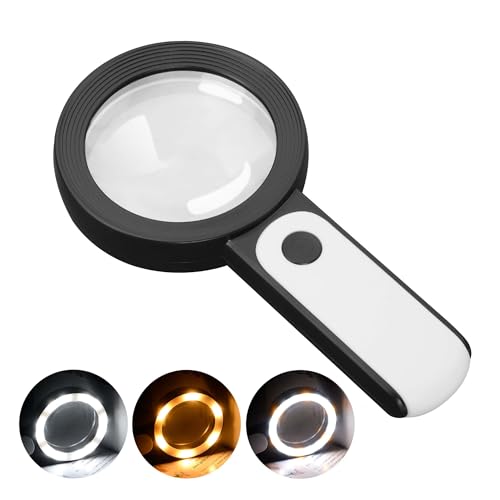
A spec-by-spec comparison of five handheld lighted magnifiers, from a 0.61 lb 18 LED model to a rechargeable 37 LED unit with 20X and 45X inlets. Which one suits your hands, your lighting and your reading distance.

By Elsie DuncanUpdated 16 min read
On this page
- Best handheld lighted magnifying glass at a glance
- How I sorted five listings into buyer profiles
- Batteries or rechargeable: which should you pick?
- How big does the lens really need to be?
- 1. JMH Magnifying Glass with Light — Best overall
- 2. AIXPI Magnifying Glass with Light Large 5" Lens — Best for pros
- 3. GABORISH Large Magnifying Glass with 37 LED Light — Best premium
- 4. KINSUTO 2000mah Rechargeable Handheld Magnifying Glass — Runner-up
- 5. Nazano Magnifying Glass with 12 LED Lights for Senior — Best budget pick
- What the magnification numbers do not tell you
- Grip, weight and hand fatigue
- The verdict
- FAQ
The best handheld lighted magnifying glass is the JMH Magnifying Glass with Light, because it pairs an 18 LED head that runs cold and warm with a 3.15 in lens and a body that weighs just 0.61 lb. If you inspect coins or stamps and need a wider viewing window, the AIXPI with its 5 in lens is the better buy. Prices across this group split into three clear tiers, and each tier buys something different: the cheapest picks buy glass and light, the middle buys lens area, and the top buys a rechargeable cell and extra magnification inlets.
Best handheld lighted magnifying glass at a glance
| Pick | Lens | Light | Price |
|---|---|---|---|
Best overall JMH Magnifying Glass with Light |
3.15 in claim | 18 LED, 3 modes 3x AAA |
Check Price |
Best for pros AIXPI Magnifying Glass with Light Large 5" Lens |
5 in | 24 LED + 1 UV 3x AAA |
Check Price |
| 5.2 in claim | 37 LED, dimmable 1000mAh USB |
Check Price | |
| 5.2 in claim | 24 LED, 3 modes 2000mAh USB |
Check Price | |
Best budget pick Nazano Magnifying Glass with 12 LED Lights for Senior |
3.5 in claim | 12 LED | Check Price |


How I sorted five listings into buyer profiles
I did not rank these by a single score. Nobody buys a magnifier in the abstract. I lined up the published specifications side by side and sorted the field into the four people who actually shop this category.
- The nightly reader. Newspaper, mail, prescription labels, a dim living room lamp. Wants light and a lens big enough to catch a full line of text.
- The inspector. Coins, stamps, circuit boards, watch movements. Wants lens area first and extreme power second.
- The hobbyist. Model work, gem work, close detail. Needs magnification well beyond reading strength.
- The gift buyer. Buying for a parent. Wants light weight, a simple switch, and no learning curve.
Every pick here maps to one of those. The JMH lands with the nightly reader, and it's the one buyers choose most often in this set by a wide margin. The AIXPI serves the inspector with the biggest confirmed lens figure of the five, a flat 5 in. The GABORISH covers the hobbyist with 20X and 45X inlets on top of its main lens. The Nazano is the gift, at 7.41 oz and the cheapest of the five.
Two things got picks cut in my head before they earned a section. Listings with no published weight are hard to recommend to someone with arthritis. Listings with no published lens figure are hard to recommend to anyone at all, because lens area is the one number that changes how a magnifier feels in use.
Batteries or rechargeable: which should you pick?
This is the split that matters most in the best handheld lighted magnifying glass market right now, and it's the one most shoppers decide last instead of first.
Three of these five run on 3x AAA cells, and none of them ship with batteries. The JMH and AIXPI listings both say so plainly. Two run on an internal cell you top up over USB: the GABORISH at 1000mAh and the KINSUTO at 2000mAh.
Neither approach wins outright. Here's the trick with AAA models: they never die permanently. A magnifier that needs a fresh set of cells is fixed in thirty seconds with a pack from the kitchen drawer, and there is no charge port to wear out. That matters if you're buying for someone who will not reliably plug anything in.
Rechargeable models trade that for continuity. You never buy cells, and a 2000mAh pack like the KINSUTO's is meant for long sessions. The cost is a charging habit and a battery that eventually holds less than it did.
- Buy AAA if the user forgets to charge things, or if the magnifier lives in a drawer for weeks at a time.
- Buy rechargeable if it gets used daily for an hour or more.
- Buy rechargeable if you dislike the running cost of alkaline cells.
- Buy AAA if you want a lighter body, since the two lightest confirmed weights here belong to AAA models.
How big does the lens really need to be?
Lens diameter is the specification I'd check before anything else, and it's the one buyers skim past on the way to the magnification number.
A bigger lens means more words visible per glance. With a 3.15 in lens like the JMH's, you catch a few words at a time and slide across the line. With a 5 in lens like the AIXPI's, you catch most of a newspaper column width. Over a forty-minute reading session that difference is the whole experience, because every slide is a small interruption.
The field here spans a real range. The Nazano's listing describes a 3.5 in glass lens. The JMH claims 3.15 in. The AIXPI publishes a flat 5 in, backed by a 5.12 x 5.12 in body footprint. The GABORISH and KINSUTO both claim 5.2 in.
There's a catch, though. Lens area and body size move together. The GABORISH measures 10.8 x 5.5 in and weighs 8 oz, the heaviest confirmed weight in this group. The AIXPI is nearly square at 5.12 x 5.12 in and weighs 0.55 lb, the lightest confirmed figure.
So the honest answer: go 5 in or larger if you read continuous text for long stretches. Stay near 3.15 to 3.5 in if you mostly check labels, price tags and dosage instructions in short bursts, and you want something you can hold one-handed without your wrist complaining.
1. JMH Magnifying Glass with Light — Best overall
The JMH is the default here because it delivers three light modes and 18 LEDs in the lightest, cheapest package that still publishes full dimensions.
Best for: nightly newspaper and prescription-label reading Skip it if: you never want to buy AAA batteries
What sets the JMH apart in this set is the light itself. It's the only pick offering both cold and warm output across 3 modes, which matters more than the raw LED count. Warm light cuts glare on glossy magazine stock. Cold light sharpens edges on printed text. Having both means you adjust the tool to the page instead of squinting through the wrong colour temperature.
The physical figures back it up. At 0.61 lb and 8.07 x 4.17 in, this is a paddle-shaped body with a handle, not a square plate. JMH says the lens measures 3.15 in across and magnifies without optical distortion. The whole thing runs on 3x AAA cells, which are not included, and the listing describes a single on/off button.
It's also the second-cheapest of the five and by far the fastest-selling pick in this group, well ahead of every other magnifier here.
The trade-off is lens area. That 3.15 in claim is the smallest here alongside the Nazano, so you'll slide across a line of newsprint more often than an AIXPI owner would. And only one seller lists it, so your options are limited if you want a choice of vendor.
Pros:
- Cold and warm output across 3 light modes
- Lightest confirmed body with a handle, 0.61 lb
- 18 LEDs for even coverage across the lens
- Fastest-selling pick in this group
- Second-cheapest of the five
Cons:
- Smallest claimed lens diameter here, 3.15 in
- 3x AAA batteries not included
- Only one seller lists it
- No published warranty
2. AIXPI Magnifying Glass with Light Large 5" Lens — Best for pros
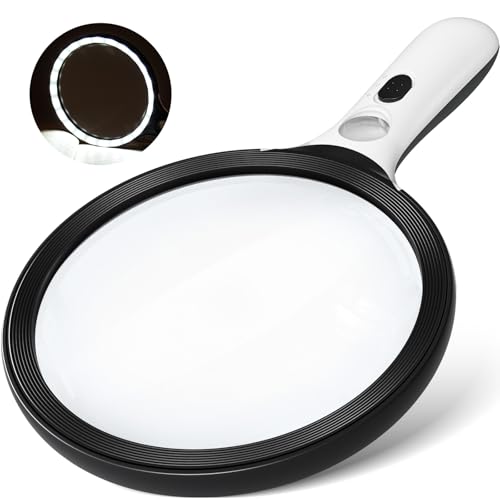
The AIXPI puts the largest confirmed lens in this set on the lightest confirmed body, and adds a UV lamp nobody else offers.
Best for: coin and stamp inspection with a wide field of view Skip it if: you need a long handle to hold at arm's length
This is the inspector's pick, and the numbers explain why. The lens is a published 5 in, listed as a size specification rather than a marketing claim, and the body measures 5.12 x 5.12 in. That's almost pure lens with a thin bezel. AIXPI describes two precision lenses working together for what it calls distortion-free clarity.
Then there's the UV lamp. Among the 24 LEDs sits 1 UV light, and no other pick in this set publishes one. That's a real functional gap if you check banknotes, security markings or fluorescent inks on stamps. It's meaningless if you only read the mail.
Weight is the quiet advantage. At 0.55 lb this is the lightest confirmed body of the five, lighter than picks with smaller lenses. The near-square shape does mean you're gripping a plate rather than a stick, which suits table work more than couch reading.
It sits third of five on price, and two sellers stock it. The catch is power: 3x AAA cells, not included, so a big 24 LED array is drawing on disposables.
Pros:
- Largest confirmed lens in this set, 5 in
- Lightest confirmed weight here, 0.55 lb
- Only pick with a dedicated UV lamp
- 24 LEDs across a near-square 5.12 in body
- Two sellers stock it
Cons:
- 3x AAA batteries not included
- Square plate shape suits table use over hand-held reading
- Listing publishes no light mode count
- No published warranty
3. GABORISH Large Magnifying Glass with 37 LED Light — Best premium
The GABORISH is the only pick here that goes past reading strength, with 20X and 45X inlets on top of its main 10X lens.

Best for: hobbyists who need extreme close-up power on top of reading Skip it if: you want the lightest thing in your hand
This is the most expensive pick here, and the money goes somewhere specific. GABORISH lists 10X on the main lens with additional 20X and 45X inlets set into it, and the listing notes the 45X gives an upright image only within 1.2 in of the subject. That's a hobbyist tool, not a reading tool. It's the difference between checking a mint mark and actually resolving a die crack.
Light is the other upgrade. 37 LEDs is the highest count in this set, and GABORISH says brightness is adjustable rather than fixed. The lens is described as 5.2 in, shatterproof and scratch-resistant, and the body runs on a 1000mAh rechargeable cell over USB, so no cells to buy.
Now the honest cost. At 8 oz this is the heaviest confirmed weight of the five, and at 10.8 x 5.5 in it's the longest body. That's a genuinely large object to hold steady. Its 1000mAh cell is also half the capacity of the KINSUTO's, despite driving more LEDs.
Pros:
- Highest LED count in this set, 37
- Only pick with 20X and 45X inlets
- Adjustable brightness rather than fixed output
- 1000mAh rechargeable cell, no batteries to buy
- Shatterproof, scratch-resistant lens per the listing
Cons:
- Heaviest confirmed weight here, 8 oz
- Longest body in the set at 10.8 in
- Smaller battery than the KINSUTO despite more LEDs
- Most expensive pick here
- 45X inlet only works within 1.2 in
4. KINSUTO 2000mah Rechargeable Handheld Magnifying Glass — Runner-up
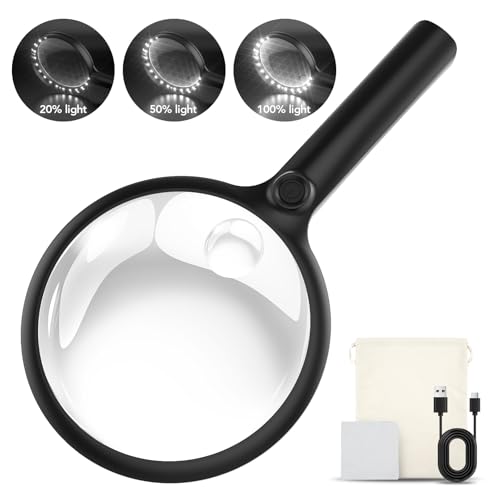
The KINSUTO carries the biggest battery in this set by a factor of two, which makes it the pick for people who read for hours at a stretch.
Best for: long uninterrupted reading sessions away from an outlet Skip it if: you want published weight and dimension figures before buying
Battery capacity is this pick's whole argument. 2000mAh is double the GABORISH's 1000mAh, and it drives 24 LEDs rather than 37, so the maths points to noticeably longer runs per charge. KINSUTO lists 3 adjustable modes at low, medium and high, which is the other half of the endurance story: dropping to low stretches a charge much further than a fixed-brightness lamp allows.
The lens is described as 5.2 in, with 5X and 10X strengths and an optical-grade PMMA build with an anti-glare coating. PMMA is acrylic, not glass. That's lighter and more shatter-tolerant than glass, and softer, so it scratches more readily if you toss it in a bag with keys.
Here's the real problem, and it's why this sits fourth rather than second. The listing publishes no weight and no dimensions. Size is given only as "Large". You're buying a body of unknown mass, which is a genuine risk if the user has weak hands or arthritis. It's also the slowest seller of the five by a wide stretch, and only one seller lists it.
Pros:
- Largest battery in the set, 2000mAh
- 3 brightness modes for stretching a charge
- 5.2 in lens claim with 5X and 10X strengths
- Anti-glare PMMA lens per the listing
- No batteries to buy
Cons:
- No published weight or dimensions
- Acrylic lens scratches more easily than glass
- Slowest seller of the five
- Only one seller lists it
- Priced in the top tier here
5. Nazano Magnifying Glass with 12 LED Lights for Senior — Best budget pick
The Nazano is the cheapest of the five and the only one whose listing specifically names polished optical glass rather than plastic.

Best for: a first magnifier for a parent or grandparent Skip it if: you read for hours in a very dark room
Nazano makes one claim the others don't, and it's worth understanding. The listing describes a double-layered polished optical glass lens and contrasts it directly with plastic, citing better clarity and light transmission. Glass resists scratching in a way acrylic can't, so a magnifier that lives loose in a handbag holds its clarity longer. The listing gives the lens as 3.5 in.
It's a small, light object. 7.41 oz across an 8 x 4 x 1.3 in body, with an ergonomic handle the listing says is aimed at users with arthritis. That 1.3 in depth is the thickest profile figure here, which points to a chunkier grip rather than a flat plate. Chunkier grips are easier to hold when fingers don't close fully.
The compromise is light. 12 LEDs is the lowest count in this set, less than a third of the GABORISH's 37. In a well-lit room that's plenty. In a dim bedroom at night, you'll notice. The listing also doesn't state a power source, so you can't plan around batteries or charging before it arrives.
Pros:
- Cheapest pick in this set
- Polished optical glass lens rather than acrylic
- Light at 7.41 oz with a thick ergonomic grip
- 3.5 in lens claim beats the JMH's figure
- Full published dimensions
Cons:
- Lowest LED count here, just 12
- Power source not stated in the listing
- No published warranty
- Only one seller lists it
What the magnification numbers do not tell you
Every listing in this category leads with an X figure. 10X, 20X, 45X. Those numbers are the least reliable thing on the page, and here's why.
Magnification and working distance are locked together. A 45X lens like the GABORISH's inlet needs the subject inside 1.2 in, which the listing states outright. That's your nose almost touching the page. Higher power also shrinks the visible area and dims the image, which is exactly why these products carry LED arrays in the first place.
Nobody reads a newspaper at 45X. Reading happens at low power over a wide field. So a magnifier's usable strength for text is set by lens diameter and light quality, not by the biggest number on the box.
Three things to check instead:
- Lens diameter. More area means fewer slides per line. The 5 in AIXPI figure is the most trustworthy in this set because it's published as a size specification.
- LED count and modes. Modes beat raw count. The JMH's cold and warm option changes more about readability than an extra ten diodes would.
- Lens material. Glass for scratch resistance, acrylic for light weight. The Nazano names glass, the KINSUTO names PMMA.
One more caution on the word "handheld". Every pick here is handheld, but a 10.8 in body at 8 oz behaves very differently in the hand from a 5.12 in square at 0.55 lb. Check the dimensions, not the label.
Grip, weight and hand fatigue
This section exists because it's the complaint the specifications predict and the marketing never mentions. A magnifier held for forty minutes is a small weight held at an awkward angle, and that is where arthritis and tremor turn a good lens into an unused drawer item.
Confirmed weights in this set run from 0.55 lb up to 8 oz. Two picks publish nothing at all, which is a real gap.
The shape matters as much as the mass. Consider three body types here:
- Paddle with handle. The JMH at 8.07 x 4.17 in and the Nazano at 8 x 4 x 1.3 in. You grip below the lens, the wrist stays neutral, and you can rest an elbow on the arm of a chair.
- Square plate. The AIXPI at 5.12 x 5.12 in. Excellent over a desk, less comfortable held up to a book on your lap.
- Long body. The GABORISH at 10.8 x 5.5 in and 8 oz. Stable on a table, tiring in the air.
If you're the gift buyer, the Nazano's 1.3 in thick ergonomic handle is the shape I'd start with. Thin flat handles are hard for fingers that don't fully close. If the recipient reads sitting at a table rather than in a chair, weight matters much less and the AIXPI's lens area wins.
The verdict
If you read printed text at night in a normal living room, buy the JMH Magnifying Glass with Light. Its 3 light modes with cold and warm output solve more real reading problems than any raw LED count does, it's 0.61 lb with a proper handle, and it's the second-cheapest pick in this set. If you inspect small objects on a table and field of view is what limits you, buy the AIXPI. Its published 5 in lens is the largest confirmed figure here and the body is the lightest at 0.55 lb, plus it carries the only UV lamp in this group.
The cutoff is your reading distance. Held up to a book in a chair, handle shape and light quality decide everything, and the JMH wins. Laid flat over coins or a circuit board on a desk, lens area decides everything, and the AIXPI wins.
Two conditions flip that. If you need genuine close-up power beyond reading, only the GABORISH offers 20X and 45X inlets, and the 37 LED array with adjustable brightness comes with it. If you read for hours away from a socket, the KINSUTO's 2000mAh cell is double any other rechargeable capacity here. The Nazano stays in the conversation as the cheapest pick with a named glass lens, provided you're not reading in the dark.
FAQ
Is a handheld lighted magnifying glass worth it over a phone camera?
A handheld lighted magnifying glass is worth it for anyone reading regularly, because a phone needs two hands, a steady grip and a bright screen aimed at your face. These picks give you a fixed working distance, an even LED ring around the whole lens, and nothing to unlock. The JMH's cold and warm modes also let you kill glare on glossy paper, which a phone flash makes worse.
How do I get the best value in this category?
The best value comes from matching the specification to your actual task instead of buying the biggest number. The Nazano is the cheapest here and its named glass lens plus 7.41 oz weight covers short label checks well. Step up to the JMH for 18 LEDs and 3 modes if you read at night. Only pay top-tier prices if you need rechargeable power or magnification past reading strength.
Do these magnifiers come with batteries included?
These magnifiers do not come with batteries included where cells are required. The JMH and AIXPI listings both specify 3x AAA cells sold separately. Two picks avoid the issue entirely: the GABORISH runs a 1000mAh rechargeable cell over USB and the KINSUTO a 2000mAh cell. The Nazano listing does not state its power source, so budget for cells to be safe.
JMH or AIXPI: which handheld lighted magnifying glass should I buy?
Choose between JMH or AIXPI by where you use it. The JMH has a handle, weighs 0.61 lb and offers cold and warm output across 3 modes, which suits reading in a chair. The AIXPI is a 5.12 in square plate with a published 5 in lens, 24 LEDs and 1 UV light, which suits desk inspection of coins and stamps. Field of view versus grip comfort.
What is the most common mistake buying a lighted magnifier?
The most common mistake is chasing the highest magnification figure. High power shrinks your visible area and forces the lens very close to the page. The GABORISH listing states its 45X inlet needs the subject within 1.2 in. For reading, lens diameter and light quality decide comfort, so compare a 3.15 in lens against a 5 in lens before comparing X numbers.
Start with what you'll actually be looking at this week. Small print in short bursts, from a chair, in a lamp-lit room describes most buyers, and that's the JMH's exact job: 18 LEDs, warm or cold, a real handle, 0.61 lb, and a switch nobody needs explained twice. The larger 5.2 in bodies and the rechargeable cells solve problems that only appear at a desk or after an hour of continuous use. Buy for the reading you do, not the hobby you might take up, and check that whichever pick you choose publishes a weight you're comfortable holding.